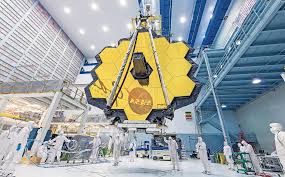
James Webb Telescope: Peering into the Dawn of Time
April 11, 2026, 2:16 p.m.The James Webb Space Telescope (JWST) represents the most significant leap in astronomical technology since the launch of Hubble. Unlike Hubble, which looks primarily at visible light, Webb peers into the infrared spectrum. This allows it to see through dense clouds of cosmic dust to reveal the birth of stars.
The engineering required to launch a 6.5-meter gold-plated mirror into space and unfold it perfectly at 1.5 million kilometers from Earth is staggering. The telescope operates at temperatures below -230°C to ensure its own heat doesn't interfere with the faint infrared signals from the edge of the universe.
Data from Webb is often converted into sound through a process called sonification, allowing scientists to "hear" the composition of distant atmospheres. These data points reveal the presence of water, carbon dioxide, and methane in the atmosphere of exoplanets orbiting distant stars. As we continue to receive data, Webb is fundamentally changing our understanding of how galaxies were formed.
Expandable Content
Webb's primary mirror is made of 18 hexagonal segments. Each is made of beryllium and coated with a layer of gold just a few atoms thick to maximize infrared reflection.
Search for the first light from stars formed after the Big Bang.
Study the formation and evolution of galaxies.
Observe the birth of stars and protoplanetary systems.
Measure the physical and chemical properties of planetary systems.